Global development division
 | This section needs additional citations for verification. (March 2014) (Learn how and when to remove this template message) |
Christopher Elias leads the foundation's efforts to combat extreme poverty through grants as president of the Global Development Program.
In March 2006, the foundation announced a $5 million grant for the International Justice Mission (IJM), a human rights organization based in Washington, D.C., US to work in the area of sex trafficking. The official announcement explained that the grant would allow the IJM to "create a replicable model for combating sex trafficking and slavery" that would involve the opening of an office in a region with high rates of sex trafficking, following research. The office was opened for three years for the following purposes: "conducting undercover investigations, training law enforcement, rescuing victims, ensuring appropriate aftercare, and seeking perpetrator accountability".
The IJM used the grant money to found "Project Lantern" and established an office in the Philippines city of Cebu. In 2010, the results of the project were published, in which the IJM stated that Project Lantern had led to "an increase in law enforcement activity in sex trafficking cases, an increase in commitment to resolving sex trafficking cases among law enforcement officers trained through the project, and an increase in services – like shelter, counseling and career training – provided to trafficking survivors". At the time that the results were released, the IJM was exploring opportunities to replicate the model in other regions.
Gates Cambridge Scholarshipsedit
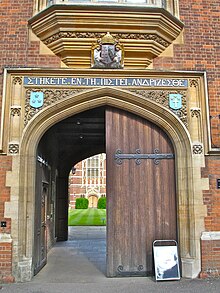
In October 2000, William Gates established the Gates Cambridge Scholarships which allow students and scholars from the U.S. and around the world to study at Cambridge University, one of the top universities in the world. The Gates Cambridge Scholarship has often been compared to the Rhodes Scholarship, given its similarly international scope and substantial endowment. In 2000, the Gates Foundation endowed the scholarship trust with $210 million to help outstanding graduate students outside of the United Kingdom study at the University of Cambridge. The Gates Foundation has continued to contribute funds to expand the scholarship, making it one of the largest and best-endowed scholarships in the world. The Gates Cambridge Scholarship accepts less than 0.3% of applicants and remains extremely competitive. Each year, approximately 100 new graduate students from around the world receive funding to study at Cambridge University.
Financial assistanceedit
- Alliance for Financial Inclusion (AFI): A $35 million grant for the AFI supports a coalition of countries from the developing world to create savings accounts, insurance, and other financial services that are made available to people living on less than $2 per day.citation needed
- Financial Access Initiative: A $5 million grant allows Financial Access Initiative to conduct field research and answer important questions about microfinance and financial access in impoverished countries around the world.
- Pro Mujer: A five-year $3.1 million grant to Pro Mujer—a microfinance network in Latin America combining financial services with healthcare for the poorest women entrepreneurs—will be used to research new opportunities for the poorest segment of the Latin American microfinance market.
- Grameen Foundation: A $1.5 million grant allows Grameen Foundation to approve more microloans that support Grameen's goal of helping five million additional families, and successfully freeing 50 percent of those families from poverty within five years.
- Grant worth $1.3 million Lawrence Muganga for his book You Can't Make Fish Climb Trees.
Agricultural Developmentedit
- International Rice Research Institute: Between November 2007 and October 2010, the Gates Foundation offered $19.9 million to the International Rice Research Institute. The goal of the aid was to support the increasing world demand for rice. The Gates Foundation claims: "To keep up with worldwide demand, the production of rice will have to increase by about 70 percent in the next two decades." The International Rice Research Institute has developed Golden Rice, a genetically modified rice variant used to combat Vitamin A deficiency.
- Alliance for a Green Revolution in Africa (AGRA): The Gates Foundation has partnered with the Rockefeller Foundation to enhance agricultural science and small-farm productivity in Africa, building on the Green Revolution that the Rockefeller Foundation spurred in the 1940s and 1960s. The Gates Foundation has made an initial $100 million investment in this effort, to which the Rockefeller Foundation has contributed $50 million.citation needed
Water, sanitation and hygieneedit
The Water, Sanitation and Hygiene (WASH) program of the Bill & Melinda Gates Foundation was launched in mid-2005 as a "Learning Initiative", and became a full-fledged program under the Global Development Division in early 2010. The foundation has since 2005 undertaken a wide range of efforts in the WASH sector involving research, experimentation, reflection, advocacy, and field implementation. In 2009, the foundation decided to refocus its WASH effort mainly on sustainable sanitation services for the poor, using non-piped sanitation services (i.e. without the use of sewers), and less on water supply. This was because the sanitation sector was generally receiving less attention from other donors and from governments, and because the foundation believed it had the potential to make a real difference through strategic investments.
In mid 2011, the foundation announced in its new "Water, Sanitation, Hygiene Strategy Overview" that its funding now focuses primarily on sanitation, particularly in sub-Saharan Africa and South Asia, because access to improved sanitation is lowest in those regions. Their grant-making focus has been since 2011 on sanitation science and technology ("transformative technologies"), delivery models at scale, urban sanitation markets, building demand for sanitation, measurement and evaluation as well as policy, advocacy and communications.
In mid 2011, the foundation stated that they had committed more than $265 million to the water, sanitation, and hygiene sector over the past five years, i.e. since about 2006. For the time period of about 2008 to mid-2015, all grants awarded to water, sanitation and hygiene projects totaled a value of around $650 million, according to the publicly available grant database.
Improved sanitation in the developing world is a global need, but a neglected priority, as shown by the data collected by the Joint Monitoring Programme for Water Supply and Sanitation (JMP) of UNICEF and WHO. This program is tasked to monitor progress towards the Millennium Development Goal (MDG) relating to drinking water and sanitation. About one billion people have no sanitation facility whatsoever and continue to defecate in gutters, behind bushes or in open water bodies, with no dignity or privacy. This is called open defecation and it poses significant health risks. India is the country with the highest number of people practicing open defecation: around 600 million people. The foundation has been funding many sanitation research and demonstration projects in India since about 2011.
Reinvent the Toilet Challengeedit
In 2011, the foundation launched a program called "Reinvent the Toilet Challenge" with the aim to promote the development of innovations in toilet design to benefit the 2.5 billion people that do not have access to safe and effective sanitation. This program has generated significant interest of the mainstream media. It was complemented by a program called "Grand Challenges Explorations" (2011 to 2013 with some follow-up grants reaching until 2015) which involved grants of $100,000 each in the first round. Both funding schemes explicitly excluded project ideas that relied on centralized sewerage systems or are not compatible with development country contexts.
Since the launch of the "Reinvent the Toilet Challenge", more than a dozen research teams, mainly at universities in the U.S., Europe, India, China and South Africa, have received grants to develop innovative on-site and off-site waste treatment solutions for the urban poor. The grants were in the order of $400,000 for their first phase, followed by typically $1 million – 3 million for their second phase; many of them investigated resource recovery or processing technologies for excreta or fecal sludge.
The "Reinvent the Toilet Challenge" is focused on "reinventing the flush toilet". The aim was to create a toilet that not only removes pathogens from human excreta, but also recovers resources such as energy, clean water, and nutrients (a concept also known as reuse of excreta). It should operate "off-the-grid" without connections to water, sewer, or electrical networks. Finally, it should costs less than 5 cents per user per day.
High-tech toilets for tackling the growing public health problem of human waste are gaining increasing attention, but this focus on a "technology fix" has also been criticized by many in the sector. However, low-tech solutions may be more practical in poor countries, and research is also funded by the foundation for such toilets.
The Reinvent the Toilet Challenge is a long-term research and development effort to develop a hygienic, stand-alone toilet. This challenge is being complemented by another investment program to develop new technologies for improved pit latrine emptying (called by the foundation the "Omni-Ingestor") and fecal sludge processing (called "Omni-Processor"). The aim of the "Omni Processor" is to convert excreta (for example fecal sludge) into beneficial products such as energy and soil nutrients with the potential to develop local business and revenue.
Examples of transformative technologies researchedit
- About 200 sanitation projects in many different countries and at various scales - some with a technology focus, some with a focus on market development or policy and advocacy, have received funding by the foundation since 2008.
- The University of KwaZulu-Natal in Durban, South Africa Gates Foundation was awarded $1.6 million in 2014 to act as a hub for sanitation researchers and product developers.
- One example of an Omni-Processor is a combustion-based system designed to turn fecal sludge into energy and drinking water. The development of this particular prototype by U.S.-based company Janicki Bioenergy attracted media attention for the sanitation crisis and the work of the foundation after Bill Gates drank water produced from this process.
- Examples for the Reinvent the Toilet Challenge include: Scientists at the University of Colorado Boulder were giving funding of $1.8 million to develop a prototype toilet that uses solar heat to treat the fecal matter and produce biochar. Funding has been provided to RTI International since 2012 to develop a toilet based on electrochemical disinfection and solid waste combustion.
Other global initiativesedit
Some examples include:
- 2004 Indian Ocean earthquake: The foundation made total grant donations of $3 million to various charities to help with the aid effort for victims of the earthquake. These charities include: CARE international, International Rescue Committee, Mercy Corps, Save the Children, and World Vision.
- 2005 Kashmir earthquake: The foundation made a donation of $500,000 for the earthquake.
- In 2014, the Gates Foundation released "flexible funds" in the order of $50 million to United Nations agencies and other organizations involved in the work against the deadly disease Ebola in West Africa.
The Foundation is working with Mastercard, GAVI and TrustStamp to create the Mastercard Well Pass. This program, being tested in 2020 in West Africa, will integrate vaccination records with cashless payment capability.


Comments
Post a Comment